
Introduction
There is a lot of noise about AI SOC analysts, and it can be hard to know which solutions actually deliver. If your team is juggling endless alerts and limited resources, the idea of AI stepping in to help sounds promising, but how do you know if it is the right fit? An AI SOC analyst is an agentic system that uses large language models (LLMs) and integrated tools to replicate the investigative techniques of expert human analysts. Added to a SOC as a teammate, it autonomously handles Tier 1 alert investigation to ease workloads, reduce burnout, and boost efficiency for your human team. The goal is to elevate your analysts, not replace them: the AI investigates the repetitive Tier 1 work and hands people a concluded position to act on.
The hard part is telling a capable system from a convincing demo. This guide gives you both halves of that decision: the criteria that separate a real AI SOC analyst from a glorified alert summarizer, grounded in what AI SOC automation can and cannot do, and a proof of concept you run on your own historical alerts so the choice rests on evidence rather than a vendor's slide.
The Business Case for AI SOC Analysts
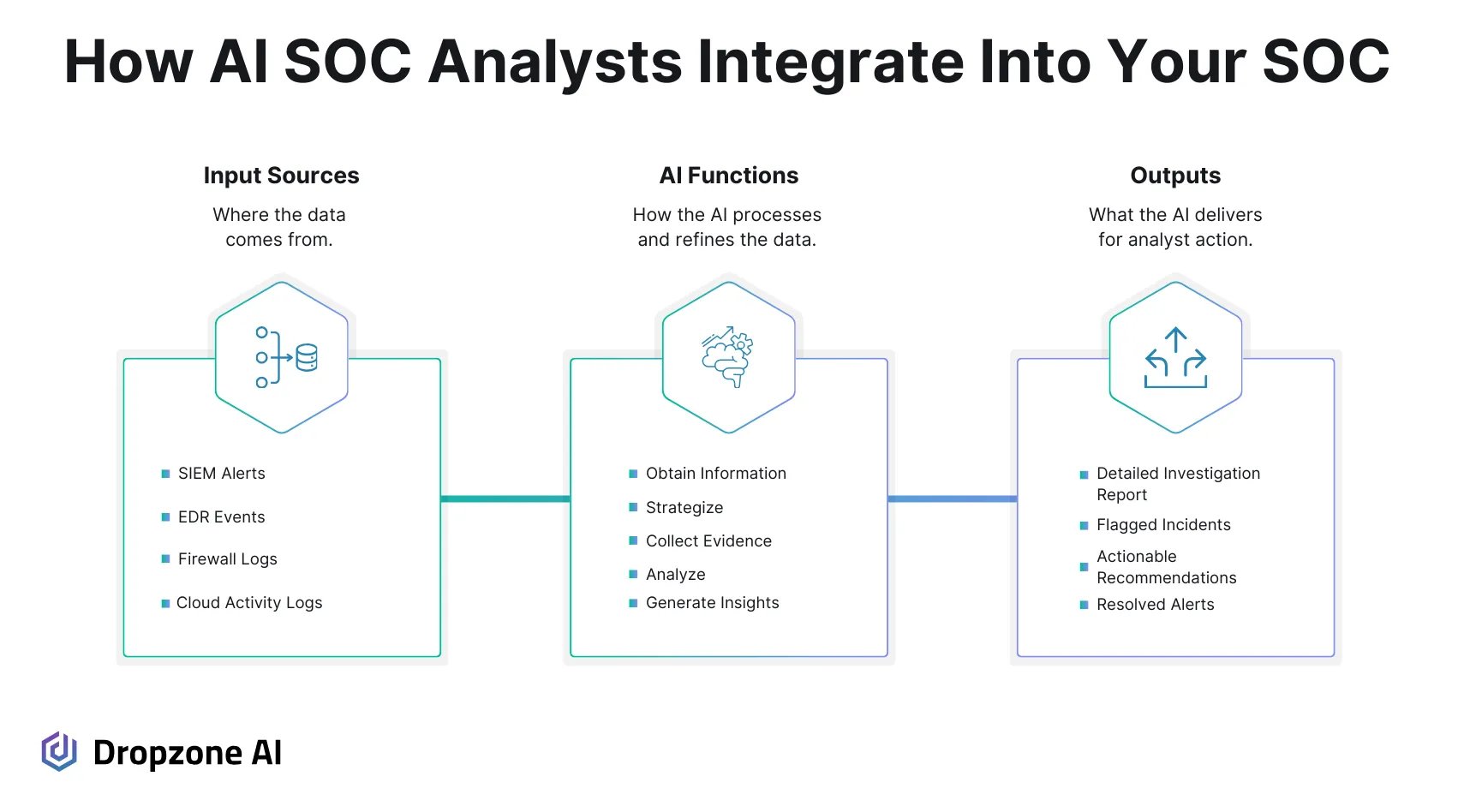
An AI SOC analyst integrates with your SOC infrastructure by pulling alerts from SIEM, EDR, firewalls, identity providers, and cloud security platforms. It runs structured investigative workflows: gathering data, querying across your tools, collecting evidence, analyzing logs, and writing detailed reports using established investigation methodologies such as OSCAR.
It then delivers a verdict backed by evidence, ready for an analyst to review and, where warranted, escalate. That saves time and sharpens decisions, because your team starts every alert from a concluded position instead of a blank console. People shift their focus from repetitive triage to the complex, high-priority threats that need human judgment.
Why They’re Needed
SOCs are under constant pressure from a never-ending stream of alerts and limited resources. Adding more security tools does not solve the problem, because those tools are not designed to take work off the team's plate. The capacity of the security team is frequently the bottleneck to getting full value from the tools already in place. An organization may turn on AWS GuardDuty alerts to fulfill a compliance requirement, then never have the time to act on the findings. An AI SOC analyst automates the repetitive Tier 1 work, alert triage and initial investigation, so teams get more out of the investments they already own. It increases the analytical capacity of the organization without scaling headcount linearly.
Automating alert triage and investigation frees human analysts for high-value work: creating detection rules, threat hunting, and incident planning. It improves efficiency and creates breathing room to think strategically rather than react to whatever alert just fired. The downstream benefits compound, including reduced alert fatigue and faster identification of real security incidents.
Use Cases
AI SOC analysts solve real problems SOCs face every day by automating and augmenting critical workflows:
- Alert Management: Automates triage for all alert types, from endpoint and network alerts to cloud security events, ensuring even low-priority alerts are thoroughly analyzed.
- Operational Scalability: Works around the clock, scaling operations to handle growing alert volumes without requiring additional staff.
- Interactive Threat Hunting and Investigation: Functions as an AI assistant or copilot so analysts can ask questions directly, like, “Were there unusual login attempts in the last 48 hours?” or “What systems did this user access in the past week?” and get accurate, actionable insights in seconds.
- Proactive Security: Frees up resources so analysts can focus on tasks that require a deeper understanding, such as policy reviews, threat research, or fine-tuning detection mechanisms.
How You Know If the Project Is Successful
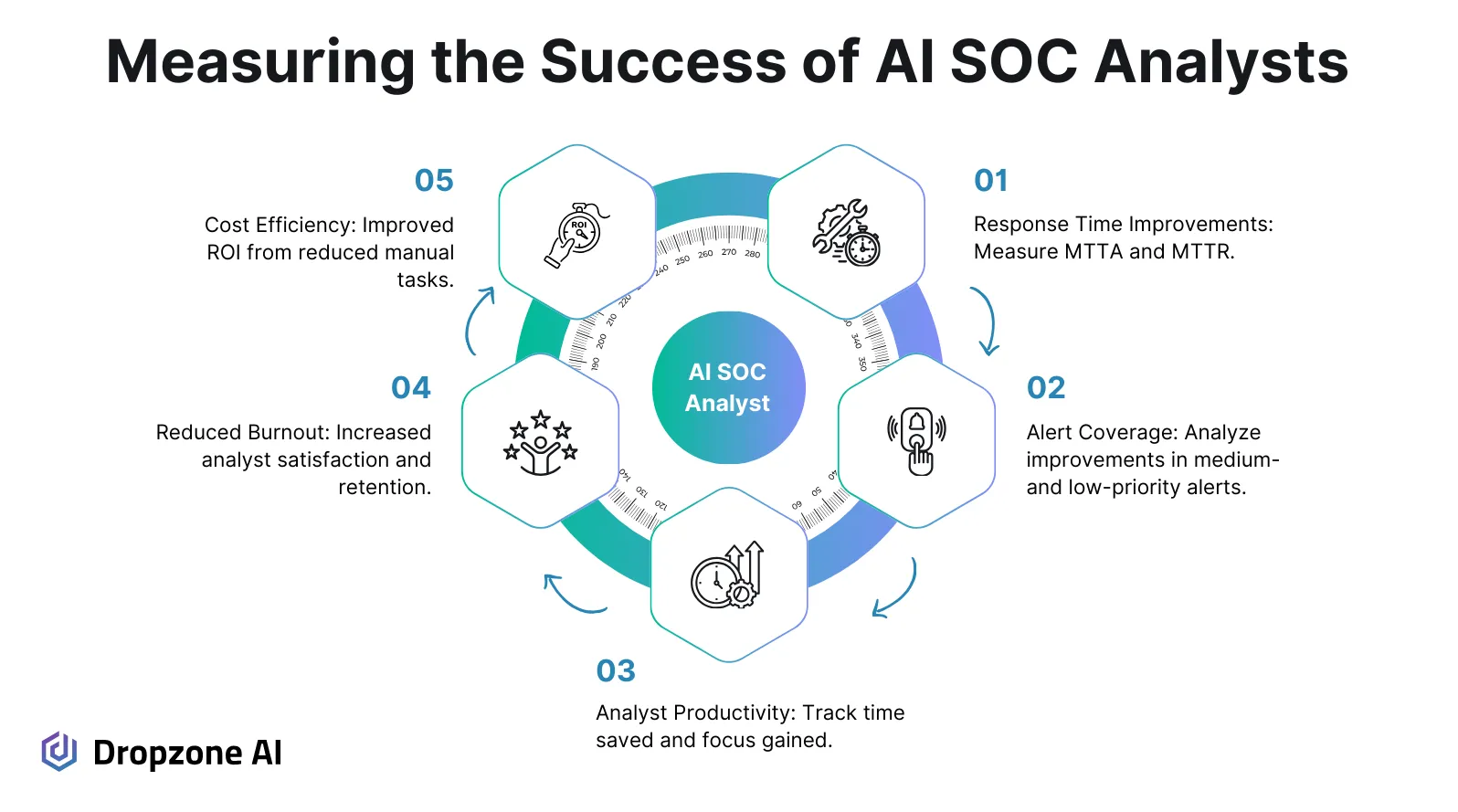
When bringing an AI SOC analyst into your team, measuring how well it’s helping your operations is important. Here are some key areas to track for a clear picture of the impact.
Response Time Improvements
Look at how quickly your SOC acknowledges and resolves incidents before and after adopting AI. Common SOC KPI metrics like Mean Time to Acknowledge (MTTA) and Mean Time to Resolve (MTTR) should show how your team reacts much faster. For example, if critical incidents escalate faster, it’s a sign the AI is doing its job.
Analyst Productivity
AI should free your analysts from repetitive tasks, giving them more time to focus on complex, high-value work. Keep an eye on the number of alerts processed per analyst and how much time they spend on proactive tasks like threat hunting. You can track how much time is saved on tasks like correlating logs or enriching alerts. If your team is spending less time triaging alerts and more time tackling real challenges, it’s a win.
Alert Coverage
AI can help your team investigate alerts that might otherwise get missed. Compare the percentage of medium- and low-priority alerts reviewed before and after AI integration. Look for patterns in how AI connects alerts to uncover larger attack chains. This can help you see whether AI is reducing blind spots and improving your team’s ability to respond to threats.
The operational improvements brought by AI SOC analysts should also have a meaningful impact on your team and your bottom line. Here’s how to measure that.
Reduced Burnout
As SOC work can be overwhelming, tracking team morale and turnover is key retention strategy. Use surveys to see how analysts feel about their workload after introducing AI. Are they reporting feeling more engaged? You can also track how the distribution of work has changed as human employees work on more proactive security projects. Remember, better analyst experiences can mean reduced risk—less alert fatigue means that analysts are less likely to miss small telltale signs of an actual security incident.
Cost Efficiency
AI can help you save money by automating repetitive tasks and speeding up incident resolution. Look at how staffing needs and overtime costs have changed since integrating AI. If your team handles more alerts without more resources, you’re seeing real ROI.
Accuracy and Trust
AI should make your SOC more effective, not add noise. Track its outputs' accuracy by reviewing false positive and false negative rates. Ask your analysts to give feedback on AI-generated investigations to improve the system’s performance. Over time, you should see AI improving and aligning more closely with your team’s needs. Evidence transparency is the metric that underwrites every other one: track whether each verdict ships with a reviewable evidence chain, because an analyst cannot trust, validate, or learn from a conclusion they cannot inspect.
How to Decide Which AI SOC Analyst Fits

Identify Use Cases First
The first step in evaluating an AI SOC analyst is understanding your SOC's unique challenges. Are you drowning in alert volumes your team cannot keep up with? Are there blind spots in your SOC coverage that could lead to missed threats? Or is your team stretched thin because you do not have enough skilled analysts? Naming these pain points helps you focus on the features and capabilities that matter most to your organization.
Features to Evaluate
When assessing AI SOC analysts, focus on the features that align with your needs and make a tangible difference in your security operations. If you want a side-by-side buyer's guide that compares the wider tooling categories, it pairs well with the criteria here. Four areas matter most:
- Adaptability: the AI should align with your environment, incorporating your workflows, configurations, and threat patterns. Look for human-in-the-loop feedback mechanisms and a way to feed in details about your IT environment, so its outputs stay accurate, relevant, and actionable for your team.
- Scalability: choose a solution that grows with your SOC. It should handle increasing alert volumes, data sources, and integrations without slowing down or compromising the depth of its investigations.
- Transparency: a strong AI system shows its work. It should explain why it flagged an alert or reached a verdict and provide an evidence chain analysts can review and validate. That builds trust and keeps oversight intact.
- Integrations: the AI SOC analyst should connect with your existing SIEM, EDR, identity, cloud, and email tools, pull data from them directly, and support end-to-end workflows without rip-and-replace.
The Role of Technical Criteria
Technical capabilities should serve your SOC's broader goals, not the other way around. Weigh integration depth, data privacy, and contextual awareness, but judge each one by whether it helps your team operate more effectively. Does the solution fit your existing workflows? Will it reduce manual work or let you cover more alerts? When you anchor the technical features to practical outcomes, the criteria you prioritize translate into real improvements in SOC performance. The surest way to confirm any of this is to test the system on your own data, which is what the proof of concept below is for.
How to Run a Proof of Concept (PoC)
Criteria tell you what to look for. A proof of concept tells you whether a specific AI SOC analyst actually delivers it in your environment. The principle is simple: do not evaluate on a vendor's curated demo, evaluate on your own alerts. A well-run PoC turns marketing claims into measured results in two to four weeks.
What to Run
Replay a representative set of your own historical alerts through the system, not synthetic samples the vendor chose. Pull a batch that spans your real detection surface: SIEM correlation alerts, EDR endpoint detections, identity and authentication anomalies, cloud security findings, and phishing or email alerts. Include the full severity range, especially the low- and medium-severity alerts your team usually cannot get to, because that backlog is where an AI SOC analyst earns its keep. Where you have ground truth (alerts a human already investigated and adjudicated), use it as your answer key so you can score the AI's verdicts against known outcomes.
What to Measure
Score the PoC on six dimensions, each tied to a criterion above:
• Investigation quality and accuracy: does the verdict match the known outcome, and is the reasoning sound? Compare the AI's true/false-positive calls against your answer key.
• Coverage of low- and medium-severity alerts: what share of the alerts your team normally leaves untouched did the system investigate end to end?
• Time to verdict: how long from alert ingestion to a concluded, evidence-backed verdict, compared with your current mean time to triage?
• False-positive handling: does it correctly dismiss benign alerts with evidence, so analysts are not re-checking its dismissals?
• False-negative handling: does it ever dismiss a true threat as benign? This is the highest-stakes failure mode and deserves the closest scrutiny.
• Evidence transparency: can an analyst open any verdict and trace the data, queries, and reasoning behind it without asking the vendor?
Decide how you will measure a pilot before you run one. Our guide to threat hunting metrics covers the KPIs that show whether an investigation program is working, so the evaluation produces evidence rather than impressions.
Pass or Fail Thresholds
Set thresholds before the PoC starts, so the result is a decision rather than a debate. Defensible, conservative bars for an enterprise SOC:
• Verdict accuracy against your answer key at or above 90 percent, with the false-negative count on confirmed threats at zero. A single missed true threat is a fail regardless of the headline accuracy number.
• End-to-end investigation coverage of at least 95 percent of the in-scope alerts you submit, including the low- and medium-severity tier. The system should investigate the alerts your team cannot, not just the easy ones.
• Time to verdict materially faster than your current Tier 1 triage time on the same alert types, and consistent across the batch rather than fast only on simple cases.
• Every verdict carries a reviewable evidence chain. If any verdict cannot be independently inspected by your analyst, transparency fails, no matter how accurate the call was.
Treat these as floors to adapt to your risk tolerance, not universal benchmarks. The point of writing them down first is that the AI SOC analyst has to clear a bar you set, on data you chose, before it earns a place on your team. A structured scorecard for running this evaluation is coming soon, so you can score competing systems on the same dimensions side by side.
Conclusion
An AI SOC analyst gives an overwhelmed SOC a way to investigate every alert, including the low- and medium-severity ones the team never reaches, while people focus on confirmed threats and strategy. Finding the right fit starts with the criteria above and ends with a proof of concept on your own alerts, scored against thresholds you set before you start. That is how you separate a system that investigates from one that only summarizes. To dig deeper into the evaluation criteria, download our AI SOC analyst buyer's guide.
Dropzone AI's AI SOC Analyst, available now, autonomously investigates every alert end to end and delivers a verdict backed by evidence for your team to act on. If you are ready to see what that looks like on your own alerts, book a call to discover how Dropzone AI can help your SOC thrive.







.png)